
How Far Can Unistrut Span?
September 15, 2026
We've all come across moments when designing a Unistrut support solution where we've wondered if a beam can span a certain width without additional support. Maybe it's for aesthetics, maybe it's because there are limited connection points, but no matter the reasoning, it can be tempting to push the boundaries of what Unistrut can do.
But to find out how far a Unistrut beam can span in your application, there are more variables to consider than just distance: acceptable deflection, the channel profile being used, and, most importantly, the value of your total uniform load.

How to Find the Weight Limit of Unistrut Channel
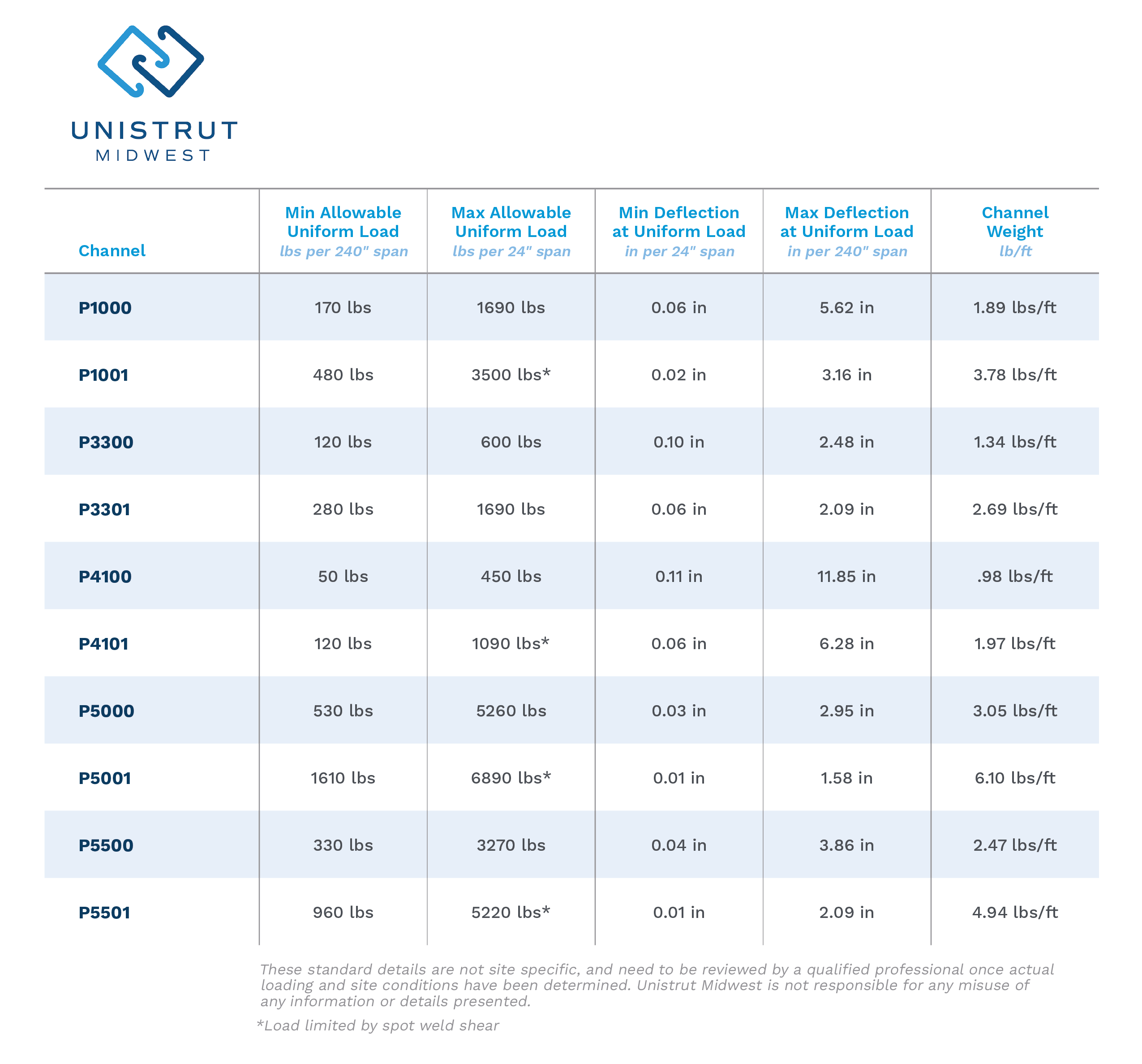
Depending on the profile, the span of your beam can impact the weight limit by thousands of pounds. Each Unistrut channel has a beam loading table in the General Engineering Catalog. That table will tell you the maximum allowable uniform load (in pounds) of a specific span of that channel.
The beam loading tables provided by Unistrut include information for single-span (simple) beams supported at both ends with spans from 24 inches to 240 inches. However, the total uniform load allowed for a 240-inch span is often quite low, with one profile supporting only 50 pounds of uniform load. That limitation makes the function of a 240-inch Unistrut beam rather limited for most applications.
Below is a high-level reference chart for calculating the weight Unistrut channels can hold.
How to Determine the Maximum Span of Unistrut Beams
To calculate how far your Unistrut beam can span, we can use the calculations that determine the weight limits of a Unistrut beam.
Step One:
Determine the maximum allowable uniform load from the load table based on your desired span in inches and whether you are designing to a deflection limit.
Step Two:
If your channel is pierced, multiply the maximum allowable uniform load found in Step One by the following factor:
- “KO” Series: 95%
- “T” Series: 85%
- “HS” Series: 90%
- “SL” Series: 85%
- “H3” Series: 90%
- “DS” Series: 70%
- “WT” Series: 85%
Step Three:
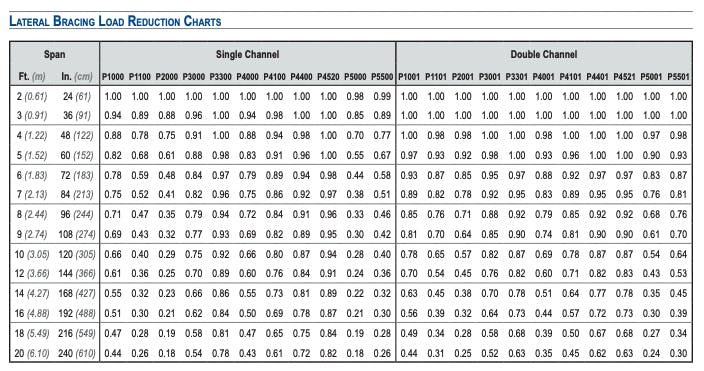
Because the goal is to find the limits of an unbraced channel, we need to use the Lateral Bracing Load Reduction Chart from page 62 of the General Engineering Catalog to multiply the maximum allowable uniform load by the applicable unbraced length factor.
Step Four:
Subtract the channel weight from your calculated maximum allowable uniform load
- This result is the net allowed total uniform load in pounds
If the resulting net allowed total uniform load matches your requirements, then congratulations! You have found a maximum span for your load. If the resulting value does not work for your requirements, however, you still have options.
Leveraging Sikla for Heavier Loads and Wider Spans
For heavier loads that need to span a further distance than Unistrut allows, we suggest Sikla siFramo. Sikla's box-frame beams support heavier loads than Unistrut, even allowing a 40-foot medical multi-trade rack to be prefabricated and lifted into place with minimal deflection.
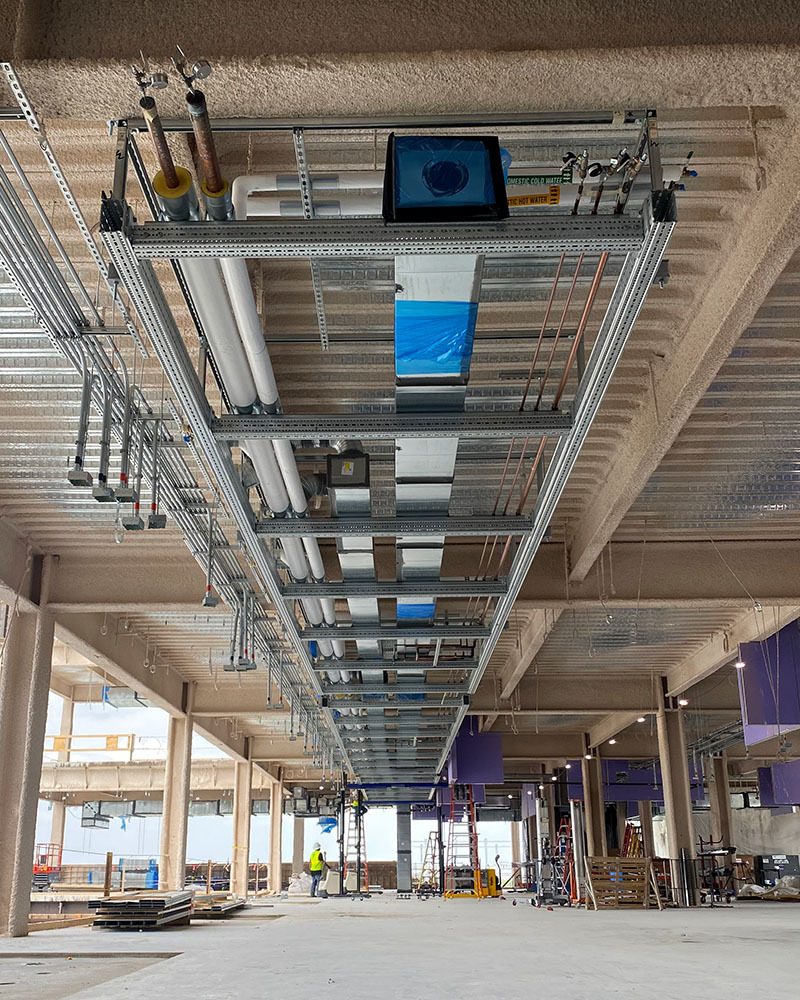
Conveniently, Unistrut and Sikla beams work well together, with Sikla pieces designed specifically to connect to strut. Leveraging these two materials together allows you to value engineer the best solution for your application.
No matter your reason for pursuing a wide-spanning Unistrut beam, it is never a good idea to go beyond the recommended width for your load, which can result in catastrophic solution failures. This is easily avoidable by following Unistrut's recommendations and working with an experienced Unistrut partner.
Our team has decades of experience designing Unistrut support solutions that meet or exceed our customers' needs. Find out how we can assist with your next project by contacting us.
More News + Insights